How to Review a TV Drama: 8 Things to Evaluate Before Giving Your Verdict
On this page
- 1. Story and Premise
- 2. Characters and Character Development
- 3. Acting Performances
- 4. Pacing
- 5. Dialogue
- 6. Production and Visual Storytelling
- 7. Emotional Impact
- 8. The Ending and Overall Payoff
- Separate Personal Taste From Quality
- Avoid Retelling the Entire Plot
- Handle Spoilers Carefully
- Do Not Let a Rating Replace the Review
- Consider the Intended Audience
- A Simple Review Structure for US Drama Hub
- Questions to Ask Before Publishing a Review
- Final Thoughts
Watching a television series for entertainment is easy. Reviewing one thoughtfully requires a little more attention.
A useful review should do more than say whether a show is good or bad. It should explain why certain elements work, where the series struggles, and what kind of viewer might enjoy it.
Learning how to review a TV drama also means separating personal preference from observations about storytelling, acting, pacing, and production.
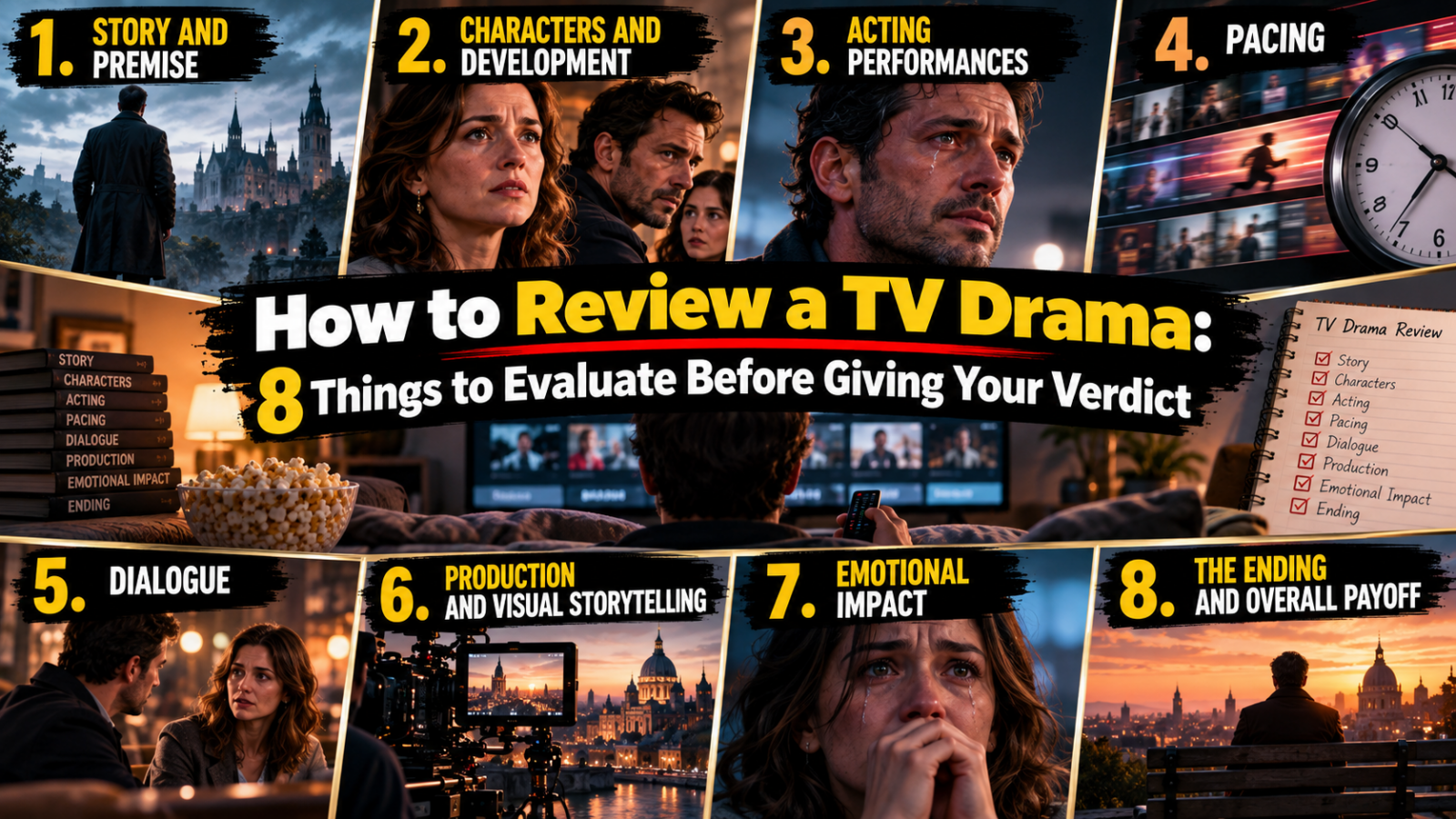
Here are eight important areas to consider when evaluating a television drama.
1. Story and Premise
Start with the basic idea behind the series.
What is the story trying to accomplish?
A strong premise should give the audience a reason to keep watching. It might introduce an unusual mystery, a complicated family conflict, a dangerous investigation, or a character facing an impossible decision.
However, an interesting premise alone is not enough.
The series must develop that idea effectively.
Ask whether the story becomes more interesting as it progresses or simply repeats the same conflicts.
Consider whether major developments feel connected to earlier events.
A good review explains whether the premise successfully supports the entire series rather than judging it only from the first episode.
2. Characters and Character Development
Characters are often the heart of television drama.
Because a series may spend many hours with the same people, viewers need reasons to remain interested in them.
When reviewing a drama, consider what each major character wants.
Are their motivations understandable?
Do their decisions make sense based on what the audience knows about them?
Characters do not need to be likable.
Some of television’s most interesting characters make terrible decisions.
What matters is whether they feel believable within the story.
Development is equally important.
If a character experiences major events but remains completely unchanged without a narrative reason, their storyline may feel unsatisfying.
Look for how experiences influence their behavior over time.
3. Acting Performances
A strong script can lose impact if the performances do not make the emotions believable.
At the same time, excellent actors can sometimes elevate relatively simple material.
When evaluating acting, avoid focusing only on dramatic scenes involving shouting or crying.
Subtle performances can be equally impressive.
A small facial expression, hesitation before answering a question, or change in body language can communicate important information.
Consider whether the actors make relationships feel convincing.
Do family members feel like people with years of shared history?
Does tension between rivals feel natural?
Does emotional dialogue sound believable?
Performance should be evaluated in relation to what the story requires.
4. Pacing
Pacing describes how quickly or slowly a story develops.
Fast pacing is not automatically good, and slow pacing is not automatically bad.
A psychological drama may intentionally spend time building atmosphere.
A thriller may depend on constant momentum.
The important question is whether the pace suits the story.
When learning how to review a TV drama, pay attention to moments when your interest changes.
Did an episode feel slow because the story was carefully developing characters?
Or did it feel slow because very little meaningful happened?
Likewise, did a fast episode feel exciting, or did important events happen too quickly to have emotional impact?
Good pacing gives important scenes enough time while keeping the narrative moving.
5. Dialogue
Dialogue performs several jobs.
It reveals personality.
It provides information.
It creates conflict.
It develops relationships.
And sometimes it simply makes characters entertaining to watch.
Strong dialogue usually sounds appropriate for the characters speaking it.
Different characters should not all sound exactly the same.
A lawyer, teenager, detective, politician, doctor, and criminal may communicate differently depending on their personalities and backgrounds.
Exposition is another important consideration.
Television occasionally needs characters to explain information to viewers.
But when conversations exist only to deliver facts, dialogue can begin to feel unnatural.
The best exposition is integrated into believable conversations and conflicts.
6. Production and Visual Storytelling
Television is a visual medium.
Writing and acting matter enormously, but cinematography, editing, locations, costumes, sound, and production design also shape the viewing experience.
A review does not need to become a technical filmmaking analysis.
Instead, consider whether the production supports the story.
A dark crime drama may use lighting and locations to create tension.
A historical drama may depend heavily on costumes and production design.
A family drama may use familiar spaces to create intimacy.
Music can also influence emotional scenes.
Ask whether these elements strengthen the story or distract from it.
Expensive production does not automatically mean good production.
What matters is how effectively the available tools serve the narrative.
7. Emotional Impact
One reason people watch drama is to feel something.
That emotion might be excitement, sadness, tension, hope, anger, fear, or curiosity.
When reviewing a series, consider whether its major emotional moments feel earned.
A character death, breakup, reunion, betrayal, or victory becomes powerful when the audience understands what it means to the people involved.
Without proper development, even a dramatic event can feel empty.
Emotional impact also depends on investment.
Did you care what happened?
Were you curious about the next episode?
Did a character decision stay in your mind after the episode ended?
These reactions can provide useful information for a review.
However, explain why the series created that response rather than simply saying it was emotional.
8. The Ending and Overall Payoff
An ending can strongly influence how viewers remember a drama.
For a completed series, ask whether the conclusion addresses the central conflicts.
Do important character arcs receive meaningful conclusions?
Are major mysteries answered?
Does the final episode match the tone and themes of the rest of the story?
Not every ending needs to explain everything.
Ambiguity can be effective.
But there is a difference between intentional ambiguity and an unresolved storyline.
If you are reviewing an ongoing series or individual season, evaluate the season finale rather than expecting complete closure.
A season ending may intentionally create new questions for future episodes.
Separate Personal Taste From Quality
This is one of the most important principles of reviewing entertainment.
You can recognize that something is well made without personally enjoying it.
For example, you may prefer fast thrillers and dislike slow character dramas.
That preference is completely valid.
But a slow series should not automatically receive negative criticism simply because it belongs to a style you do not enjoy.
Instead, explain your perspective.
You might write that viewers who enjoy deliberate character-driven storytelling may appreciate the series more than audiences looking for constant action.
That information is far more useful than simply calling the show boring.
Avoid Retelling the Entire Plot
A review and a recap serve different purposes.
A recap explains what happened.
A review evaluates how well it worked.
Some plot information is necessary to provide context, but summarizing every scene can overwhelm the actual analysis.
A useful review might briefly explain the premise and then focus on:
storytelling,
characters,
performances,
pacing,
production,
and overall effectiveness.
Readers who want a detailed summary can visit an Episode Recap instead.
Handle Spoilers Carefully
Reviews can usually be written without revealing major surprises.
If spoilers are necessary, clearly warn readers before discussing them.
For example:
Spoiler Warning: The following section discusses major events from the season finale.
This gives readers a choice.
Avoid placing major spoilers in headlines or featured images unless the article is specifically designed as an Ending Explained or spoiler-focused article.
Do Not Let a Rating Replace the Review
A numerical rating can summarize an opinion, but it cannot explain it.
Two reviewers might both give a series the same score for completely different reasons.
The written analysis is therefore more valuable than the number itself.
If US Drama Hub eventually introduces ratings, they should support the review rather than replace it.
Readers should understand the strengths and weaknesses of a series even if they ignore the final score.
Consider the Intended Audience
Not every television drama is made for every viewer.
A complex political thriller and a light relationship drama may have completely different goals.
Evaluate whether the series succeeds at what it is trying to be.
Also help readers understand who may enjoy it.
For example:
Viewers who enjoy mysteries may appreciate a story built around unanswered questions.
Fans of character-driven drama may prefer a slower series focused on relationships.
People looking for a quick weekend watch may prefer a limited series.
This makes the review useful as a recommendation tool.
A Simple Review Structure for US Drama Hub
For future reviews of specific television series, US Drama Hub can use a consistent structure.
Introduction
Briefly introduce the show and its premise.
What Works
Discuss the strongest aspects of the series.
What Could Be Better
Explain weaknesses with specific reasoning.
Characters and Performances
Evaluate the main characters and acting.
Story and Pacing
Discuss how effectively the narrative develops.
Production
Mention visual or technical elements when relevant.
Final Thoughts
Summarize the viewing experience and explain what type of audience may appreciate the series.
This structure can be adjusted depending on the show.
The goal is consistency without making every review sound identical.
Questions to Ask Before Publishing a Review
Before publishing, ask yourself:
Did I explain my opinions?
Did I provide useful examples without unnecessarily spoiling the story?
Did I separate personal preference from broader observations?
Did I evaluate more than just the plot?
Did I tell readers what type of viewer might enjoy the series?
Did I write the review in my own words?
If the answer is yes, the review will usually provide more value than a simple rating or plot summary.
Final Thoughts
Understanding how to review a TV drama means looking beyond whether you personally liked the series.
A thoughtful review considers the story, characters, acting, pacing, dialogue, production, emotional impact, and ending.
Most importantly, it explains the reasoning behind its conclusions.
The goal is not to tell every reader what they must think.
A useful review gives readers enough context and analysis to decide whether a television drama sounds right for them.
That approach makes reviews more informative, more trustworthy, and more useful long after the original series has been released.