A Jewelry Clerk Called Security on an Old Man in Paint-Stained Clothes. Then the Guard Took Off His Cap
A jewelry store karma story from Beverly Hills: a clerk called security on an old man buying a ring, but the guard recognized him. Who was Mr. Hayes?
On this page
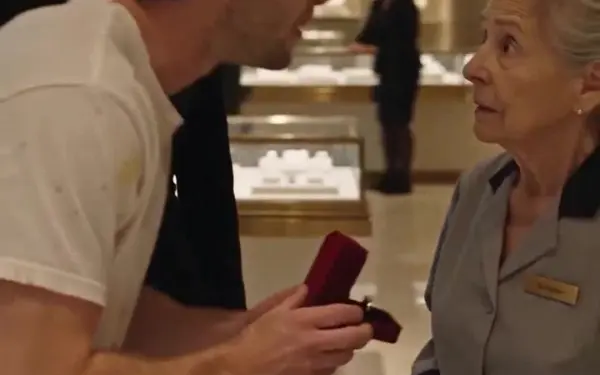
This jewelry store karma story was filmed by a shopper in a bright, glittering store in Beverly Hills, the kind of place with white marble floors, soft piano music and glass cases that cost more than most people’s cars. Into that store, on a weekday afternoon, walked Walter, 75, in a paint-stained flannel shirt and work boots.
He had come to buy a ring.
"This Isn't a Pawn Shop"
In the first second of the video, the clerk, Chad, about 30, in a slim navy suit and perfectly gelled hair, snatches a velvet tray of rings away from Walter just as he reaches for it.
“Don’t touch that, sir,” Chad says, loud enough for the whole store to hear. “This isn’t a pawn shop.”
Walter doesn’t raise his voice. He explains, calmly, that he wants a ring for his wife. They have been married for fifty years, and he never bought her a real one. They were too broke when they got married, and somehow life never stopped being busy.
Chad smirks. Then he turns and waves at the security guard standing by the door.
The shoppers start to whisper. A woman near the camera says, under her breath, “Oh, come on.”
The Security Guard Stopped Cold
The guard, Marcus, is a big, serious man in his forties in a black suit and cap. He walks over the way security guards do, slow and steady, ready to escort somebody out.
Then he sees Walter’s face, and he stops.
In the video you can see his whole posture change. His shoulders drop. He takes off his cap and holds it in both hands. And his voice cracks when he speaks.
“Mr. Hayes? Sir… you don’t remember me?”
Chad’s smirk freezes on his face. That’s where the clip cuts.
Who Was Mr. Hayes?
For thirty-four years, Walter Hayes was the janitor at a middle school in South Los Angeles. He mopped the floors, fixed the boilers and, as it turns out, quietly ran something that never appeared in any school budget.
“There was a closet in the basement next to his office,” Marcus said. “If you came to school hungry, you went to that closet. There was always cereal, peanut butter, granola bars. Nobody had to ask. Nobody had to fill out a form.”
Marcus was twelve when his mother lost her job. For most of seventh grade, the food in that closet was breakfast, and some days dinner too. When his shoes fell apart, a new pair showed up in his locker. When he got into a fight and was about to be suspended, Mr. Hayes sat with him for an hour and talked him down.
“He paid for all of it himself,” Marcus said. “Out of a janitor’s salary. For thirty years.”
What Marcus Did Next
The rest of the scene was described by the shopper who filmed it.
Marcus put his cap back on, turned to Chad, and said, very politely, that Mr. Hayes would be helped by someone else. Then he walked over to the store manager and spoke to her quietly. The manager came out, apologized to Walter personally, and brought out the tray of rings again.
Walter took his time. He picked a simple gold band with one small diamond. When the manager rang it up, Walter pulled out a worn envelope of cash. He had been saving for it for almost three years, from his pension and odd painting jobs, which is why his shirt had paint on it.
He was a few hundred dollars short.
Before anyone could say anything, Marcus put his own card on the counter.
“I told him, Mr. Hayes, I’ve been trying to pay you back for twenty-five years,” Marcus said. “Let me do this one thing.”
The Karma
Chad was not fired, but the video spread fast enough that the store’s owner made a public statement about how every customer should be treated, regardless of what they wear. Chad was moved off the sales floor. Several people commented that they had been treated the same way in that store, and the company said it was retraining its staff.
Walter gave his wife, June, the ring on their fiftieth anniversary at a backyard dinner. Marcus was there. So were nine other former students who heard the story and reached out. One of them is now a doctor, one is a teacher at the same middle school, and one runs a food bank.
June cried when she saw the ring. Then she cried harder when she found out who paid for part of it.
“I married a good man,” she said. “I just didn’t know how many people knew it.”
Have you ever been judged by what you were wearing? Share this with someone who taught you that kindness comes back around.