A Teen Girl Pulled an 83-Year-Old Man Out of His Wheelchair Seconds Before the Train Hit. Then He Whispered, “My Wife Was Right Behind Me”
A Georgia teen pulled an elderly man from his stuck wheelchair seconds before a freight train hit. Then he remembered his wife. Here is what happened next.
On this page
The crossing on Pecan Mill Road, about four miles outside Cordele, Georgia, has no station, no houses, and no warning beyond two striped gates and a pair of red lights. On a Tuesday evening in October, sixteen-year-old Kayla Briggs was biking home from her job at a peach stand when she saw an elderly man in a wheelchair get stuck in the groove beside the rail just as the gates came down around him.
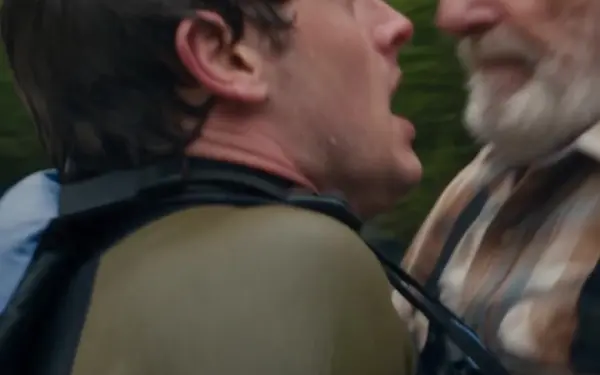
A freight train was coming. Kayla dumped her bike, ran under the gate, and tried everything to free the chair. When nothing worked, she screamed, “Sir, grab my neck! Now!” and pulled him out of the wheelchair. They tumbled into the gravel less than two seconds before the locomotive smashed the empty chair off the tracks.
Then, as the freight cars roared past, the old man gasped the words that froze her: “My wife… she was right behind me.”
The Longest Ninety Seconds
The man’s name was Walter Hensley. He was eighty-three, married sixty-one years to a woman named June. They lived in a small white house half a mile up Pecan Mill Road, and every evening, rain or shine, they made the same trip together to the Dollar General on the other side of the tracks. Walter in his wheelchair. June beside him on her little blue mobility scooter.
That evening, June had been a few yards behind him. Walter remembered hearing her scooter’s motor. He remembered her saying something about her purse. Then the bells started, and his wheel dropped into the groove, and everything after that was noise.
The train took ninety more seconds to pass. Kayla said later it felt like an hour. Walter didn’t stop calling his wife’s name the whole time. He tried to crawl toward the tracks twice, and twice Kayla wrapped both arms around him and held him back.
“I kept telling him, ‘She’s okay, she’s okay,'” Kayla said. “But I didn’t know that. I didn’t know anything.”
What Was on the Other Side
When the last car finally rolled past, the far side of the crossing came into view.
June Hensley was sitting on her blue scooter, safely behind the lowered gate, exactly where it had stopped her. She was alive. She was unhurt. And she was holding her phone up in both shaking hands, pointed straight at them.
She had stopped to pick up her purse when it slid off the basket. That ten-second delay was the only reason she wasn’t on the tracks with her husband. When the gates came down between them, she couldn’t reach him, couldn’t run, couldn’t do anything at all. So she did the only thing she could think of. She dialed 911 with one hand and started recording with the other, because, as she said later, “If my husband was going to die, I wanted somebody to know it wasn’t his fault.”
The moment the gates lifted, June drove that scooter across the tracks faster than it had ever gone. Walter pulled himself up onto his knees in the gravel, and she climbed off and fell into his arms. Kayla sat a few feet away and cried into her bleeding elbow.
The Twist Nobody Expected
The train’s engineer, a man named Curtis Odom, walked back nearly half a mile along the tracks after the train finally stopped. He was shaking. He had been driving freight for twenty-two years and had never been that sure he was about to kill someone.
When he reached them, he took one look at Walter and stopped cold.
“Mr. Hensley?”
It turned out Walter Hensley had worked for the railroad for thirty-eight years. He had been a section foreman. In 1968, he and his crew had laid the very rails on Pecan Mill Road. And in 1991, Curtis Odom had been a nineteen-year-old kid on Walter’s track crew, the one Walter taught how to read a rail, how to respect a train, and how to never, ever take a crossing for granted.
“He trained me,” Curtis said. “And I almost…” He couldn’t finish the sentence.
Walter just reached up and grabbed his hand. “You hit the brakes, son. That’s all anybody can do.”
What Happened After
June’s video, combined with the sideways footage still recording in Kayla’s hoodie pocket, went to the county commission, then to the railroad. For years, Walter had complained that the flangeway on that crossing was too wide and the planks were rotting. Nobody listened to an old man in a wheelchair. They listened to the video.
Within six weeks, the crossing on Pecan Mill Road was rebuilt with smooth rubber panels, a pedestrian path, and new gates. The railroad also announced a review of rural crossings across the region.
Kayla received a commendation from the Crisp County Sheriff’s Office and a scholarship from the railroad’s employee foundation, funded in part by a collection Curtis Odom started among the engineers. Walter got a new wheelchair, bright red, which he says is “faster than June’s scooter now.”
And every Tuesday evening, the Hensleys still make their trip to the Dollar General. Only now, they stop at the peach stand first. Kayla always has two peaches set aside for them.
More Stories Like This
If this story moved you, explore more true-to-life stories on US Drama Hub: ordinary people, split-second courage, and the moments that change families forever. Share it with someone who needs a reminder that heroes are often just kids on bikes who refuse to walk away.