A 7-Year-Old Had Three Pennies for the Hospital Vending Machine. The Stranger Who Knelt Beside Him Asked His Mom’s Name
A boy with three pennies prayed at a hospital vending machine so his sick mom could eat. A kind stranger knelt beside him, and her numbers changed that night.
On this page
It was after eleven at night on the fourth floor of a hospital in Cedar Rapids, Iowa. Rain was running down the tall windows at the end of the hallway. The fluorescent lights hummed. Most of the families had gone home or fallen asleep in the plastic recliners. Seven-year-old Noah Parker was wide awake.
His mother, Sarah, 35, had been admitted three days earlier with a blood infection that had spread faster than anyone expected. Noah’s grandmother was supposed to pick him up but had been stuck in Des Moines by the storm. So Noah, in an oversized blue hoodie and untied sneakers, had been sleeping on a cot beside his mom’s bed. That night he noticed that her dinner tray had gone back untouched. She had not eaten all day.
Three Pennies
Noah went looking for food the only way a seven-year-old knows how. He found the vending machine by the elevators, glowing in the dim hallway, full of crackers and granola bars and apples in plastic boxes. He dug into his hoodie pocket and pulled out everything he had: three pennies.
A night nurse at the station down the hall, who later shared the story, says she saw him press the pennies flat against the glass, one by one, like he could push them through. Then she heard him whisper.
“Please, God. Mom hasn’t eaten.”
She was about to get up and go to him when she saw that someone already had.
The Man in the Linen Shirt
She describes him as a man who looked to be in his early thirties, with shoulder-length dark hair, a short beard, and a plain off-white linen shirt that seemed wrong for a cold, rainy Iowa night. She had not seen him come off the elevator. She did not recognize him as anyone’s visitor. He simply knelt down on the tile next to Noah so they were eye to eye.
“What’s your mom’s name?” he asked.
“Sarah,” Noah said. “She’s really sick.”
The man put one hand on Noah’s shoulder. The nurse says this is the part she has trouble explaining to people. The hallway looked warmer. Not brighter, exactly. Warmer, the way a kitchen looks when someone has been baking. The hum of the lights seemed to go quiet.
“Tell Her She’s Not Alone”
The man reached beside him and handed Noah a brown paper bag. It was warm. Inside was a small loaf of bread and a red apple. “Take this to her,” he said. “Tell her she’s not alone.”
Noah ran. His sneakers slapped down the hallway and he burst into room 412, where his mother was propped up in her hospital gown, pale and exhausted. He climbed onto the bed and pushed the bag into her hands. “A man gave it to me. He said to tell you you’re not alone.”
Sarah says she remembers smiling weakly and thinking her son had charmed some kind security guard. She broke off a piece of the bread. It was still warm, as if it had just come out of an oven. She ate the whole thing.
The Numbers
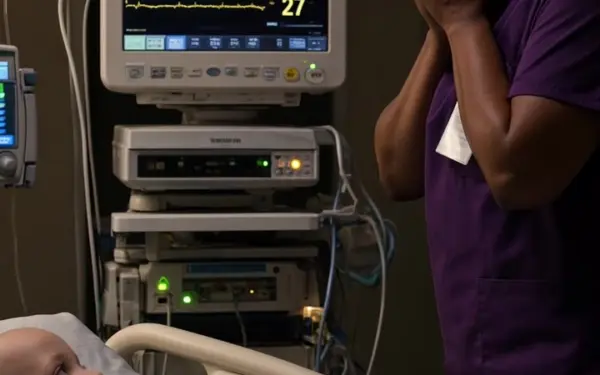
About twenty minutes later, the night nurse came in to check Sarah’s vitals. For three days, the monitor had been showing the same alarming pattern: racing heart rate, low blood pressure, a fever that would not break. The nurse looked at the screen, then at the chart, then back at the screen.
“Her numbers,” she said out loud, to no one in particular. “They’re normal.”
The fever had dropped. Her heart rate had steadied. When her blood was tested again in the morning, the infection markers had fallen so sharply that the attending physician ordered the test repeated, assuming a lab error. The second test said the same thing.
The Hallway
While the nurse was checking the monitor, Noah slipped off the bed and ran back out into the hallway to say thank you. The hallway was empty. The vending machine glowed. The elevator doors were closed, and its display showed it had not moved from the lobby.
On the floor in front of the machine were Noah’s three pennies, lined up neatly in a row. The nurse saw them too. She says they were gleaming, not dull brown like old pennies, but bright, almost golden, as if they had been freshly polished. Noah picked them up and put them back in his pocket.
Security footage from that floor was reviewed later at Sarah’s request. It shows Noah at the vending machine. It shows him kneeling as if listening to someone. It shows him running back to the room with a paper bag. The camera angle does not clearly show anyone else.
Where They Are Now
Sarah was discharged five days later. Her doctors describe her recovery as “remarkably fast” and leave it at that. She is back at work as a school bus driver, and every Sunday, she and Noah drop a bag of groceries at the food pantry at their church.
Noah keeps the three pennies in a small glass jar on his nightstand. When kids at school ask about them, he tells them the same thing every time. “He asked me her name. He already knew it. He just wanted me to say it.”
More Stories Like This
If this story touched your heart, read our stories about the little girl in a snowstorm led home by a stranger who left no footprints, the nurse who watched a dying boy reach toward a light, and the family rescued from a flooded roof by a man who knew all their names. Some prayers are answered in ways nobody can explain.