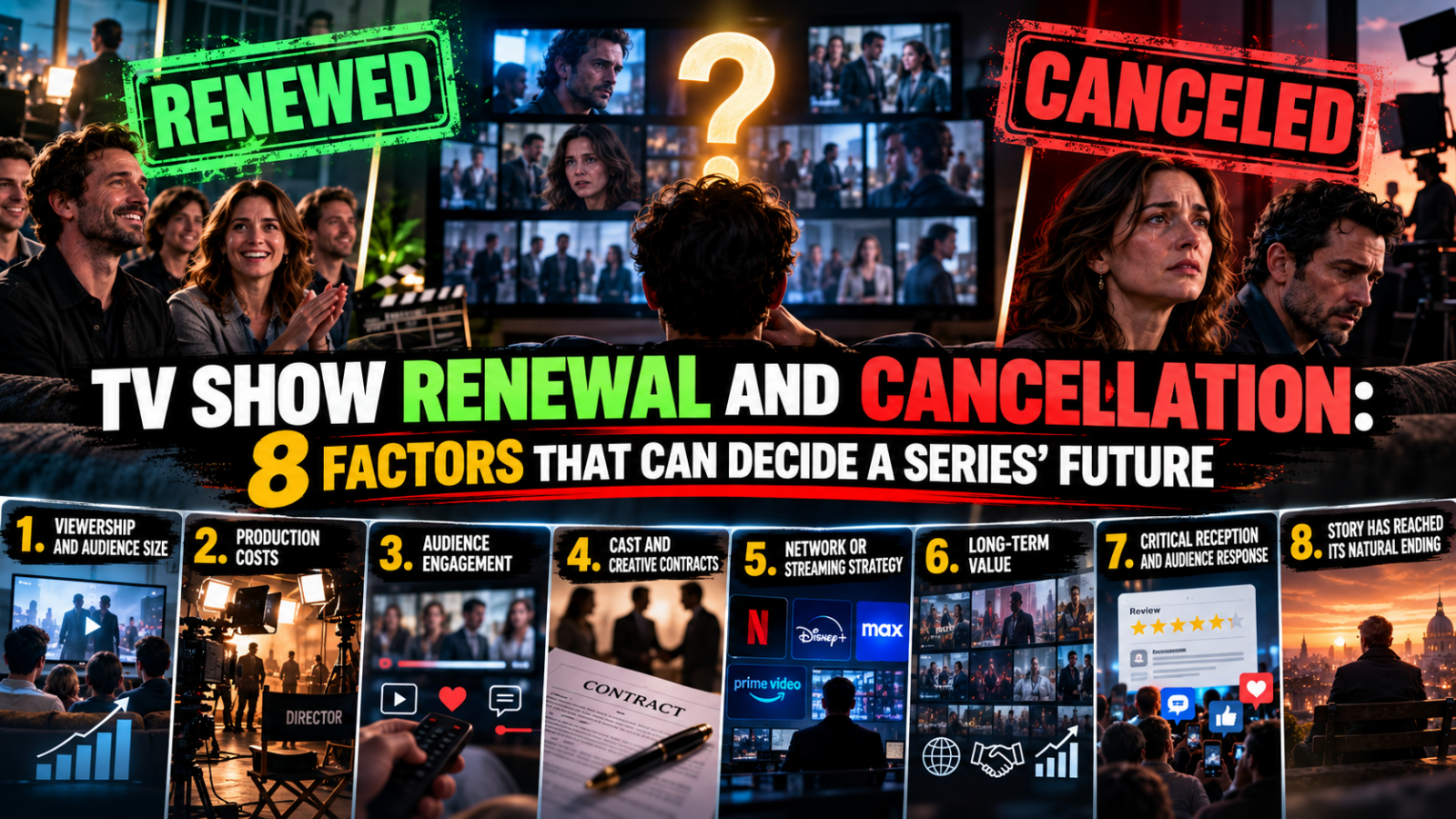
TV Show Renewal and Cancellation: 8 Factors That Can Decide a Series’ Future
On this page
- 1. Viewership and Audience Size
- 2. Production Costs
- 3. Audience Engagement
- 4. Cast and Creative Contracts
- 5. Network or Streaming Strategy
- 6. Long-Term Value
- 7. Critical Reception and Audience Response
- 8. Whether the Story Has Reached Its Natural Ending
- Renewal Does Not Always Mean Production Starts Immediately
- Cancellation Does Not Always Mean the Story Is Gone Forever
- Be Careful With Renewal Rumors
- Renewal, Cancellation, and Release Date Are Different Questions
- How US Drama Hub Should Cover Renewal News
- Why Publication Dates Matter
- Should Fans Trust Social Media Posts?
- Why a Popular Show Can Still End
- Final Thoughts
One of the biggest questions surrounding any television series is simple:
Will there be another season?
For viewers, the answer can feel unpredictable. A show with passionate fans may suddenly end, while another series continues for several seasons.
But TV show renewal and cancellation decisions are rarely based on a single factor.
Networks, studios, and streaming services may consider audience size, production costs, contracts, business strategy, and many other factors before deciding whether a series should continue.
Understanding these factors can help viewers separate confirmed information from speculation.
Here are eight important considerations that can influence the future of a television series.
1. Viewership and Audience Size
Audience size is one of the most obvious factors.
Television is ultimately competing for viewers.
If a large number of people consistently watch a series, that can give the company behind it a reason to continue investing in new episodes.
However, measuring television audiences has become increasingly complicated.
Traditional broadcast television has historically relied heavily on ratings, while streaming platforms can evaluate viewing behavior using their own internal data.
The raw number of viewers is not always the only consideration.
Companies may also care about who is watching, how consistently they watch, and whether the series attracts the audience the platform wants to reach.
That is why comparing two shows using a single public number may not reveal the complete picture.
2. Production Costs
A successful television drama can still be expensive to produce.
Major costs may include:
- actors,
- writers,
- directors,
- locations,
- sets,
- visual effects,
- costumes,
- post-production,
- and production crews.
As a series continues, some of these costs can increase.
A show therefore does not simply need viewers.
The company behind it must decide whether its performance justifies the investment required for another season.
This is one reason two series with similar audience sizes could receive different decisions.
One may simply cost significantly more to produce.
3. Audience Engagement
The number of people who start a show does not necessarily tell the entire story.
Engagement can provide additional context.
Do viewers finish episodes?
Do they continue from one episode to the next?
Do they complete the season?
Does the show generate sustained interest after release?
For streaming television especially, completion and continued viewing can potentially provide useful information about how strongly audiences respond to a series.
A show that attracts curiosity but loses viewers quickly may perform differently from one that keeps audiences watching until the finale.
However, viewers should be careful when discussing these metrics because platforms do not always publicly disclose every factor used in their internal decisions.
4. Cast and Creative Contracts
A television series depends on people.
Actors, writers, producers, directors, and other creative professionals may have contractual agreements affecting whether production can continue.
As a series becomes successful, negotiations can become more complicated.
A major actor may decide not to return.
Contracts may need to be renegotiated.
Scheduling conflicts can appear.
The creative team may also decide that the story has reached its natural conclusion.
Sometimes a show’s future therefore depends on more than audience demand.
Even a popular series can face challenges if important members of the production cannot return.
5. Network or Streaming Strategy
Television companies constantly adjust their strategies.
A network may decide to focus on a particular type of programming.
A streaming platform may change how much it invests in original dramas.
Companies may prioritize certain markets, genres, release strategies, or audience groups.
These broader decisions can affect individual shows.
This means a cancellation does not always indicate that a series had no audience.
Sometimes the show may no longer fit the company’s future programming strategy.
When reporting TV show renewal and cancellation news, this distinction is important.
A decision should not automatically be interpreted as a judgment about the creative quality of a series.
6. Long-Term Value
A television show can continue creating value after its initial release.
New viewers may discover earlier seasons.
A completed series can remain part of a streaming library.
Some shows generate interest internationally.
Others may support licensing, franchise development, or related projects.
Companies can therefore consider more than immediate performance.
The long-term value of a recognizable series may influence how much a studio or platform is willing to invest in its future.
However, much of this business information is not publicly available.
Unless a company provides specific details, outside observers should avoid presenting assumptions as confirmed explanations.
7. Critical Reception and Audience Response
Reviews and audience reactions can contribute to the conversation surrounding a series.
Strong critical reception may help a show gain attention.
Awards recognition can increase visibility.
Positive word of mouth may encourage new viewers to start watching.
A passionate fan community can also demonstrate that a series has an engaged audience.
But reviews alone generally should not be treated as proof that a show will be renewed or canceled.
A highly praised drama may still face business challenges.
Likewise, a series with mixed reviews may continue if it performs well according to the metrics that matter to its distributor.
Reception is one part of a much larger picture.
8. Whether the Story Has Reached Its Natural Ending
Not every television series is supposed to continue indefinitely.
Sometimes a story simply reaches its intended conclusion.
Characters complete their arcs.
The central conflict is resolved.
The creative team may feel that another season would weaken the ending.
In these cases, a series ending is different from an unexpected cancellation.
This distinction matters.
A planned final season gives writers an opportunity to construct a deliberate conclusion.
An abrupt cancellation may leave major storylines unresolved because the creators expected another season.
When covering the end of a show, US Drama Hub should clearly distinguish between:
renewed for another season,
canceled,
ending with a planned final season,
and a limited series that was designed as a self-contained story.
These situations are not interchangeable.
Renewal Does Not Always Mean Production Starts Immediately
When a series is renewed, viewers may assume the next season will arrive soon.
That is not always the case.
A renewal confirms that another installment is planned, but production still involves many stages.
Scripts may need to be completed.
Actors and locations need scheduling.
Filming must take place.
Episodes then require editing, sound work, visual effects, and other post-production.
The release date may therefore remain unknown even after a renewal announcement.
For accurate reporting, renewal status and release date should be treated as separate pieces of information.
Cancellation Does Not Always Mean the Story Is Gone Forever
Television history includes shows that have returned in different forms after appearing to end.
A canceled series might theoretically be revived elsewhere.
A story could continue through a spinoff.
Characters may appear in another related project.
Years later, a revival could be developed.
But these possibilities should never be reported as facts without confirmation.
Fan campaigns, social media trends, rumors, and speculation can be interesting, but they are not the same as an official announcement.
Until a reliable source confirms a return, the correct status remains unchanged.
Be Careful With Renewal Rumors
Renewal rumors can spread extremely quickly online.
A social media post might claim:
“Season 2 confirmed!”
But the actual source may simply be an actor saying they would like to return.
That is not confirmation.
Another article may claim that a new season is “expected,” but provide no official announcement.
Again, that is not confirmation.
Before US Drama Hub publishes renewal news, the information should ideally be traced back to a reliable source.
That may include an official network or streaming platform announcement, a studio statement, or reputable entertainment reporting based on clearly identified information.
Renewal, Cancellation, and Release Date Are Different Questions
These three topics are often confused.
Renewal: Has another season officially been ordered or announced?
Cancellation: Has the company decided not to continue the series?
Release Date: When will confirmed new episodes become available?
A show can be renewed without having a release date.
A show can also have production reports circulating before a platform announces exactly when viewers can watch it.
Keeping these concepts separate makes entertainment reporting clearer.
How US Drama Hub Should Cover Renewal News
For future TV News articles, we can use a simple structure.
Current Status
Start with the confirmed status:
Renewed / Canceled / Final Season / Not Yet Announced
What Has Been Officially Confirmed?
Explain exactly what the network, platform, studio, or other reliable source has announced.
When Was It Announced?
Include the date of the announcement so readers know how current the information is.
Is There a Release Date?
If yes, provide the confirmed date.
If not, clearly state that a release date has not been announced.
Who Is Expected to Return?
Only list cast members whose involvement is confirmed or reliably reported.
What Could the Next Season Cover?
This section can discuss unresolved storylines, but theories should be clearly labeled as speculation.
This format will make future news articles easier to update when new information becomes available.
Why Publication Dates Matter
Renewal information can become outdated quickly.
An article published in January may say that no decision has been announced.
By March, the show could be renewed.
By June, production might begin.
Later, a release date could be announced.
That is why TV news articles should display clear publication or update dates.
When important information changes, an existing article can be updated rather than leaving readers with outdated information.
Accuracy is more valuable than being first.
Should Fans Trust Social Media Posts?
It depends on the source.
An announcement from an official network, streaming platform, production company, or verified account directly associated with a series can be useful.
But screenshots can be edited.
Fan accounts can misunderstand statements.
Old announcements can be reposted without context.
Before treating a social media claim as news, check where the information originally came from.
If the original source cannot be identified, it is safer to describe the information as unconfirmed rather than presenting it as fact.
Why a Popular Show Can Still End
Popularity is important, but popularity alone does not reveal the complete economics of television.
A show could have a substantial audience while also becoming increasingly expensive.
Another series might have a smaller audience but cost much less to produce.
A platform may also have strategic reasons for changing its programming.
Without access to the company’s internal data, outside viewers usually cannot know every reason behind a decision.
That is why articles should avoid claims such as:
“The show was canceled because nobody watched it.”
Unless reliable evidence specifically establishes that explanation, it is too definitive.
A more accurate report explains what is known and clearly separates it from interpretation.
Final Thoughts
TV show renewal and cancellation decisions can involve far more than whether viewers liked a series.
Audience size, production costs, engagement, contracts, company strategy, long-term value, reception, and the natural direction of the story can all play a role.
Many of these factors are not completely visible to the public.
For viewers, the most reliable approach is therefore simple:
Look for official confirmation.
Check when the information was published.
Separate renewal from release-date news.
And treat rumors as rumors until reliable evidence confirms them.
For US Drama Hub, following those principles will help future TV News coverage remain accurate, useful, and easy to update as new information becomes available.