Why TV Drama Endings Matter: 7 Things That Make a Finale Satisfying

On this page
- 1. The Main Conflict Reaches a Meaningful Conclusion
- 2. Character Arcs Receive Payoff
- 3. Important Relationships Are Addressed
- 4. Earlier Details Gain New Meaning
- 5. The Ending Matches the Story’s Tone
- 6. Major Questions Receive Enough Answers
- 7. The Final Scene Leaves a Lasting Impression
- Does a Good Finale Need a Happy Ending?
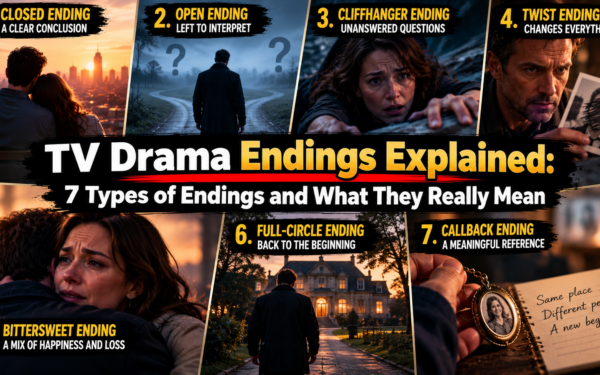
- Open Endings Can Still Be Satisfying
- What Makes an Ending Feel Rushed?
- Why Some Endings Divide Audiences
- Ending Explained vs. Episode Recap
- How US Drama Hub Should Explain Endings
- Spoiler Warnings Are Essential
- Final Thoughts
Great television can keep viewers invested for hours, seasons, and sometimes years. But when the final episode arrives, one question becomes especially important:
Was the journey worth it?
That is why TV drama endings can have such a powerful influence on how audiences remember an entire series.
A finale does not need to answer every question or give every character a happy ending. However, it should usually provide enough payoff to make the story feel meaningful.
Here are seven elements that can help make a television drama finale satisfying.
1. The Main Conflict Reaches a Meaningful Conclusion
Most dramas establish a central conflict early in the story.
A detective wants to solve a case.
A family struggles to stay together.
A lawyer fights for justice.
A character tries to escape their past.
Whatever the central conflict may be, viewers spend significant time watching it develop.
The finale should therefore address that conflict in a meaningful way.
This does not mean the protagonist must succeed.
Failure can create a powerful ending too.
What matters is that the conflict reaches a point that feels connected to everything that came before.
If a series spends years building toward one question and simply ignores it in the finale, viewers may feel that their investment was wasted.
2. Character Arcs Receive Payoff
Plot is only one part of a finale.
Characters matter just as much.
Throughout a television drama, characters make decisions, build relationships, experience consequences, and gradually change.
A satisfying finale reflects that journey.
Imagine a character who spends several seasons learning to trust other people.
Their final important decision should ideally reveal something about that development.
Another character may spend the series pursuing power only to discover what that ambition has cost them.
A strong ending connects final choices to earlier character development.
The audience should be able to look at who the characters were at the beginning and understand how they arrived at the ending.
3. Important Relationships Are Addressed
Television drama often depends on relationships as much as individual characters.
Friends, siblings, parents, children, romantic partners, colleagues, mentors, and rivals can become central to the story.
A finale does not need to resolve every relationship perfectly.
But the most important ones should usually receive attention.
Perhaps two characters finally reconcile.
Maybe a friendship ends permanently.
A romantic relationship could continue, change, or reach a natural conclusion.
Even an unresolved relationship can work if the ambiguity feels intentional.
What matters is acknowledging relationships that played a major role in the series.
4. Earlier Details Gain New Meaning
Some of the most memorable TV drama endings connect back to earlier parts of the story.
A location from the first episode might return.
A character may repeat an important phrase with a completely different meaning.
An object that once seemed insignificant could become emotionally important.
These callbacks create a sense of structure.
They remind viewers how much has changed since the story began.
The technique is particularly effective when the callback does more than create nostalgia.
A strong callback reveals development.
The same situation can produce a different decision because the character is no longer the person they once were.
5. The Ending Matches the Story’s Tone
Not every drama needs a happy ending.
Some stories naturally lead toward hope.
Others are tragic, bittersweet, unsettling, or intentionally ambiguous.
A satisfying finale should feel appropriate for the story that preceded it.
Imagine a dark psychological drama suddenly giving every character a perfect outcome without explanation.
Even if viewers like the characters, the ending might feel disconnected from the rest of the series.
The opposite can happen too.
A generally hopeful story can feel unnecessarily cynical if the finale suddenly introduces tragedy purely for shock value.
Consistency of tone helps an ending feel earned.
6. Major Questions Receive Enough Answers
Mystery is a powerful storytelling tool.
Unanswered questions keep viewers curious.
However, there is a difference between intentional ambiguity and simply failing to resolve important storylines.
If a drama repeatedly asks viewers to care about a mystery, audiences naturally expect some form of payoff.
Not every detail needs explanation.
In fact, explaining everything can sometimes reduce the impact of an ending.
The goal is balance.
Resolve the questions necessary to understand the main story while allowing smaller uncertainties to remain when appropriate.
A good finale knows which answers viewers truly need.
7. The Final Scene Leaves a Lasting Impression
The last scene has a special responsibility.
It is the final image viewers take away from the series.
Some finales end quietly.
Others use a major reveal, emotional reunion, symbolic image, time jump, or unexpected final decision.
There is no single correct approach.
The final scene works best when it represents something important about the overall story.
It may show how far a character has come.
It could demonstrate that a cycle has finally ended—or that one is beginning again.
Sometimes a simple image can communicate more than another long conversation.
The goal is not necessarily to shock viewers.
It is to leave them with something meaningful to think about after the credits appear.
Does a Good Finale Need a Happy Ending?
No.
A happy ending can be satisfying when the characters have earned it.
But happiness is not the only form of payoff.
A tragedy can be powerful if it follows naturally from the characters’ choices.
A bittersweet ending may combine success and loss.
An ambiguous ending can invite viewers to decide what they believe happens next.
The emotional tone matters less than whether the conclusion feels appropriate.
An ending should emerge from the story rather than feeling imposed on it.
Open Endings Can Still Be Satisfying
An open ending intentionally leaves part of the future uncertain.
This does not necessarily mean the writers failed to finish the story.
For example, the central conflict may be resolved while the characters’ future remains open.
That can work because real life rarely provides complete certainty.
The problem appears when too many major story questions remain unanswered.
An effective open ending gives viewers enough information to understand the meaning of the conclusion while still leaving room for interpretation.
What Makes an Ending Feel Rushed?
A rushed ending often occurs when several major developments happen without enough time for characters to react.
Important conflicts may suddenly disappear.
Relationships can change with little explanation.
Major decisions may happen because the plot needs to finish rather than because the characters have naturally reached them.
Pacing becomes especially important near the end of a series.
The final episode should have enough space for consequences.
If a huge event occurs five minutes before the credits and nobody has time to process it, viewers may understand what happened without feeling its emotional impact.
Why Some Endings Divide Audiences
Different viewers expect different things from finales.
Some prioritize answers.
Others care more about character development.
Some want emotional closure, while others enjoy ambiguity and interpretation.
This means even carefully constructed finales can divide audiences.
A controversial ending is not automatically a bad ending.
The more useful question is whether the finale follows the themes, characters, and conflicts established throughout the series.
Viewers can dislike an outcome while still recognizing that the story built toward it.
Ending Explained vs. Episode Recap
These two article formats serve different purposes on US Drama Hub.
An Episode Recap explains the important events throughout an episode.
An Ending Explained article focuses primarily on the final developments and what they mean.
For example, an ending explanation may examine:
- the final character decision,
- an important reveal,
- an ambiguous final scene,
- connections to earlier episodes,
- unresolved questions,
- and possible implications.
This distinction will help us keep the two categories useful rather than publishing nearly identical articles in both.
How US Drama Hub Should Explain Endings
When we begin covering specific television series, an Ending Explained article should separate facts from interpretation.
A useful structure is:
What happened in the ending?
First describe what viewers clearly see.
Why did the character make that decision?
Connect the choice to previous events.
What did the final scene mean?
Explain symbolism or context when supported by the story.
What remains unanswered?
Identify genuine uncertainties.
What could happen next?
If the series is continuing, discuss possibilities while clearly labeling them as theories rather than confirmed events.
This approach prevents speculation from being presented as fact.
Spoiler Warnings Are Essential
An Ending Explained article is naturally full of spoilers.
Readers should know that immediately.
Place a clear warning near the beginning:
Spoiler Warning: This article discusses major plot details and the ending of the series or episode.
Avoid revealing major twists unnecessarily in featured images.
Headlines may sometimes need to mention the subject of an ending, but they should avoid exposing surprises that readers could see accidentally while browsing the homepage.
Final Thoughts
The best TV drama endings do not simply stop the story.
They complete something meaningful.
The main conflict reaches a conclusion. Characters make choices that reflect their journeys. Important relationships receive attention. Earlier details may gain new significance, and the final scene leaves viewers with an image or idea worth remembering.
Not every question needs an answer.
Not every character needs happiness.
And not every viewer needs to agree with the outcome.
What matters is whether the ending feels connected to the story that came before it.
When a finale achieves that, the final episode can strengthen everything viewers experienced along the way.