TV Drama Endings Explained: 7 Types of Endings and What They Really Mean
On this page
- 1. The Closed Ending
- 2. The Open Ending
- 3. The Cliffhanger Ending
- 4. The Twist Ending
- 5. The Bittersweet Ending
- 6. The Full-Circle Ending
- 7. The Callback Ending
- How to Understand an Ambiguous TV Drama Ending
- Does Every Unanswered Question Need an Explanation?
- Why Some TV Drama Endings Divide Viewers
- How to Decide What an Ending Really Means
- Final Thoughts
TV drama endings explained well can completely change how we understand a story.
A finale is not always designed to answer every question. Some endings provide complete closure, while others deliberately leave viewers uncertain. A final scene can reveal a hidden truth, bring a character back to where the story began, introduce one last twist, or simply show that life continues after the main conflict ends.
That is why two viewers can watch exactly the same ending and interpret it differently.
Understanding the type of ending a drama uses can make it easier to recognize what the writers were trying to accomplish.
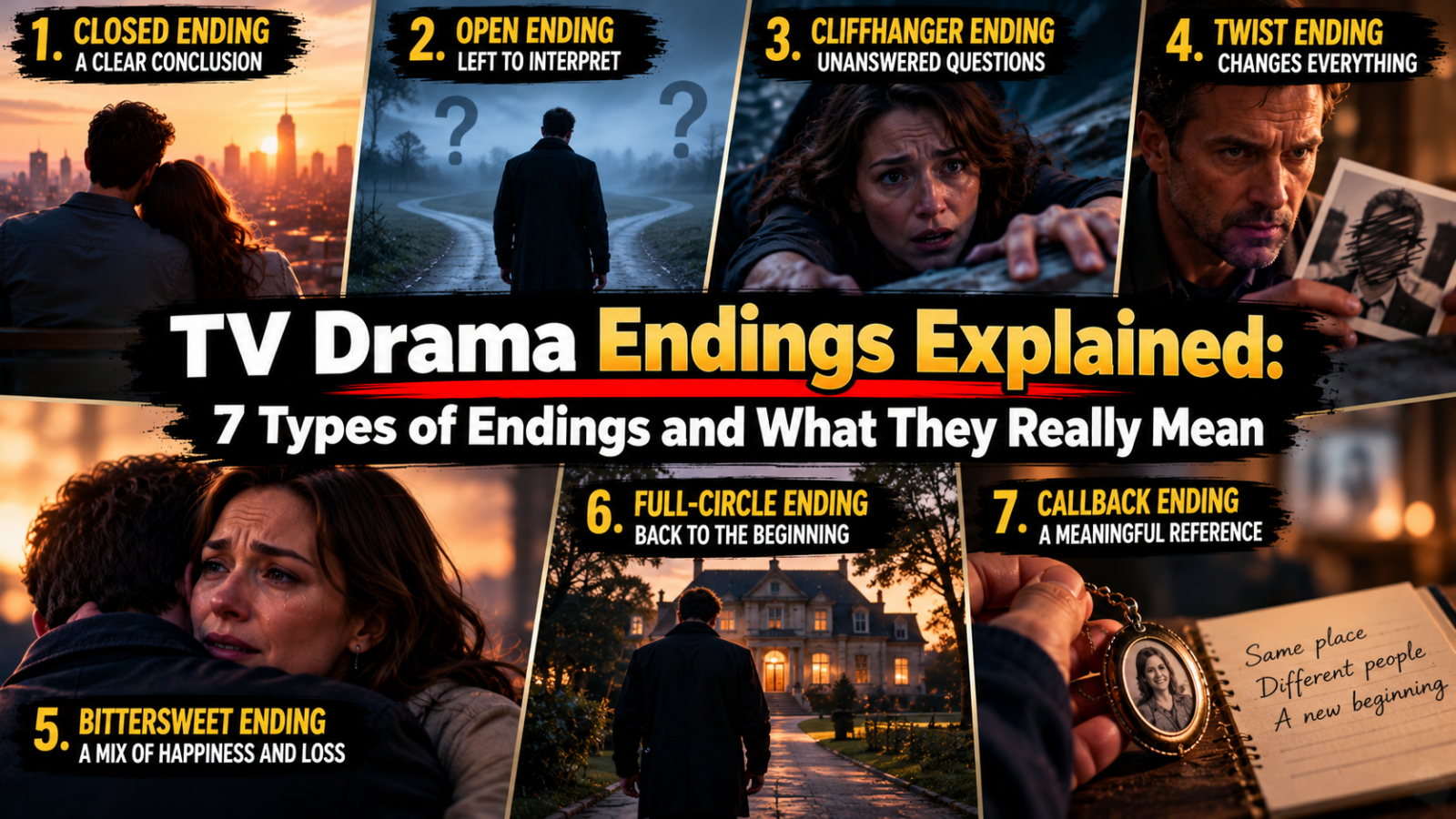
Here are seven common types of TV drama endings and what they can mean.
1. The Closed Ending
A closed ending provides clear answers to the story’s major questions.
The central conflict is resolved, important character arcs reach recognizable conclusions, and viewers generally understand what happens to the people they have been following.
This does not mean every minor detail needs an explanation.
Instead, the major promises made by the story receive satisfying conclusions.
For example, a long-running investigation may finally be solved. A central relationship may reach a clear decision. A character pursuing a major goal may succeed, fail, or realize that the goal was never what they truly needed.
Closed endings can be especially satisfying after a long serialized drama because viewers have invested significant time in the characters.
What it usually means: The story wants to provide emotional and narrative closure rather than encourage major speculation about what happens next.
2. The Open Ending
An open ending deliberately leaves part of the story unresolved.
The audience may not know exactly what a character chooses, what happens to a relationship, or what comes next.
This can be frustrating when viewers expect a definitive answer, but ambiguity is not automatically a storytelling failure.
Sometimes uncertainty is the point.
An open ending may suggest that a character’s future depends on choices they have not yet made. It may also encourage viewers to interpret the story according to the themes and character development they have already seen.
The key difference between an effective open ending and an incomplete one is intention.
A strong open ending gives viewers enough information to form meaningful interpretations even if it does not confirm one final answer.
What it usually means: The story wants the audience to continue thinking about the characters and possibilities after the screen goes dark.
3. The Cliffhanger Ending
A cliffhanger creates an immediate unanswered question.
Someone may discover shocking information. A character could suddenly disappear. A new threat may emerge. An important decision might be interrupted before viewers learn the outcome.
Cliffhangers are particularly common at the end of episodes and seasons.
Their purpose is straightforward: create enough curiosity that viewers want to continue.
However, a cliffhanger is different from an open ending.
An open ending may intentionally remain ambiguous forever. A cliffhanger generally implies that an answer exists and is expected to arrive later.
That distinction matters when interpreting a finale.
What it usually means: The current chapter is ending, but the larger story is not finished.
4. The Twist Ending
A twist ending changes the audience’s understanding of what they have already watched.
Perhaps a trusted character was hiding something important. Maybe an event happened differently from how viewers originally understood it. New information could reveal that a character’s motivation was completely different.
The strongest twists do more than surprise.
They make earlier scenes more meaningful when viewed again.
Small pieces of dialogue, character behavior, or visual details may suddenly make sense after the reveal.
A twist that appears without any foundation can feel arbitrary. A carefully prepared twist makes viewers think, “The clues were there—I just interpreted them differently.”
What it usually means: The writers want viewers to reconsider earlier assumptions about the story.
5. The Bittersweet Ending
Not every satisfying ending is completely happy.
A bittersweet conclusion combines success with loss.
A character may achieve a major goal but lose an important relationship. A family might repair some relationships while accepting that others cannot return to what they once were.
Someone may make the right decision while still experiencing painful consequences.
These endings can feel particularly realistic because life rarely divides neatly into total victory or complete failure.
The emotional impact comes from recognizing both what was gained and what had to be sacrificed.
What it usually means: Growth and success can have costs, and moving forward does not erase everything that happened before.
6. The Full-Circle Ending
A full-circle ending deliberately connects the finale with the beginning.
The final scene might return to a familiar location, repeat a line of dialogue, recreate an earlier situation, or show a character facing a similar choice in a completely different way.
This structure highlights change.
Imagine a character who was afraid to make an important decision in the first episode. In the finale, they encounter a similar situation but respond with confidence.
The circumstances look familiar, but the person has changed.
Full-circle storytelling can create a strong sense of completion without needing to explain every detail directly.
What it usually means: The story wants viewers to compare who the characters were at the beginning with who they have become.
7. The Callback Ending
A callback ending references an earlier moment in the series.
It might involve an object, location, phrase, song, promise, relationship, or decision that longtime viewers recognize.
Callbacks reward attention and memory.
A simple object can carry significant emotional meaning if viewers remember its history. Likewise, repeating an earlier line in a new context can show how much a relationship has changed.
Callbacks and full-circle endings are similar, but they are not identical.
A full-circle ending often recreates the structure of the beginning. A callback may reference any meaningful point from earlier in the story.
What it usually means: The finale is connecting the present to the history viewers experienced with the characters.
How to Understand an Ambiguous TV Drama Ending
When an ending feels confusing, start with character motivation rather than searching immediately for a hidden answer.
Ask three questions:
What did the character want?
What changed before the final scene?
What choice does the ending suggest they are now prepared to make?
Then consider visual information.
Where does the final scene take place? Is the location familiar? Does the camera emphasize a particular object or person? Does the scene resemble an earlier moment?
Finally, think about the main theme of the story.
A drama about ambition may end by showing what success ultimately costs. A story about family might conclude with reconciliation—or with a character accepting that some relationships cannot be repaired.
The ending often makes more sense when interpreted through the larger theme rather than as an isolated scene.
Does Every Unanswered Question Need an Explanation?
No.
Television dramas often contain dozens of characters, relationships, and smaller storylines.
A finale does not necessarily need to explain what happens to every person.
The more important question is whether the central conflicts and character journeys received enough resolution.
Some unanswered details can make the fictional world feel larger because they suggest that life continues beyond the final episode.
Problems arise when a series spends significant time building a central mystery or promise and then abandons it without meaningful resolution.
There is a difference between deliberate ambiguity and simply leaving an important storyline unfinished.
Why Some TV Drama Endings Divide Viewers
Different viewers expect different things from finales.
Some want clear answers.
Others enjoy ambiguity and interpretation.
Some care most about plot resolution, while others are more interested in whether the characters reached emotionally satisfying conclusions.
Expectations also matter.
If a series spends years building toward one specific question, viewers are naturally more likely to expect an answer.
By contrast, a character-driven drama may be able to leave several plot details unresolved while still providing a satisfying emotional ending.
This is why disagreement about finales is common.
Two viewers may understand an ending perfectly and still disagree about whether they found it satisfying.
How to Decide What an Ending Really Means
Start with what the episode actually shows.
Separate confirmed events from assumptions.
Then examine character development, recurring themes, earlier callbacks, and visual clues.
Be careful about treating every fan theory as established fact.
An interpretation can be persuasive without being officially confirmed by the story or its creators.
When we publish ending explanations on US Drama Hub, it is useful to distinguish between:
What happened on screen
What the ending strongly suggests
What remains open to interpretation
That distinction makes an ending analysis clearer and more useful.
Final Thoughts
With TV drama endings explained through character motivation, themes, and storytelling structure, confusing finales often become much easier to understand.
A closed ending offers resolution. An open ending invites interpretation. A cliffhanger promises more story. A twist changes what viewers thought they knew. A bittersweet ending combines achievement with loss, while full-circle and callback endings connect the finale to the journey that came before it.
The most important question is not always, “Did the ending answer everything?”
Sometimes a better question is:
“What does this ending tell us about how the characters have changed?”
That is often where the real meaning of a television drama finale can be found.