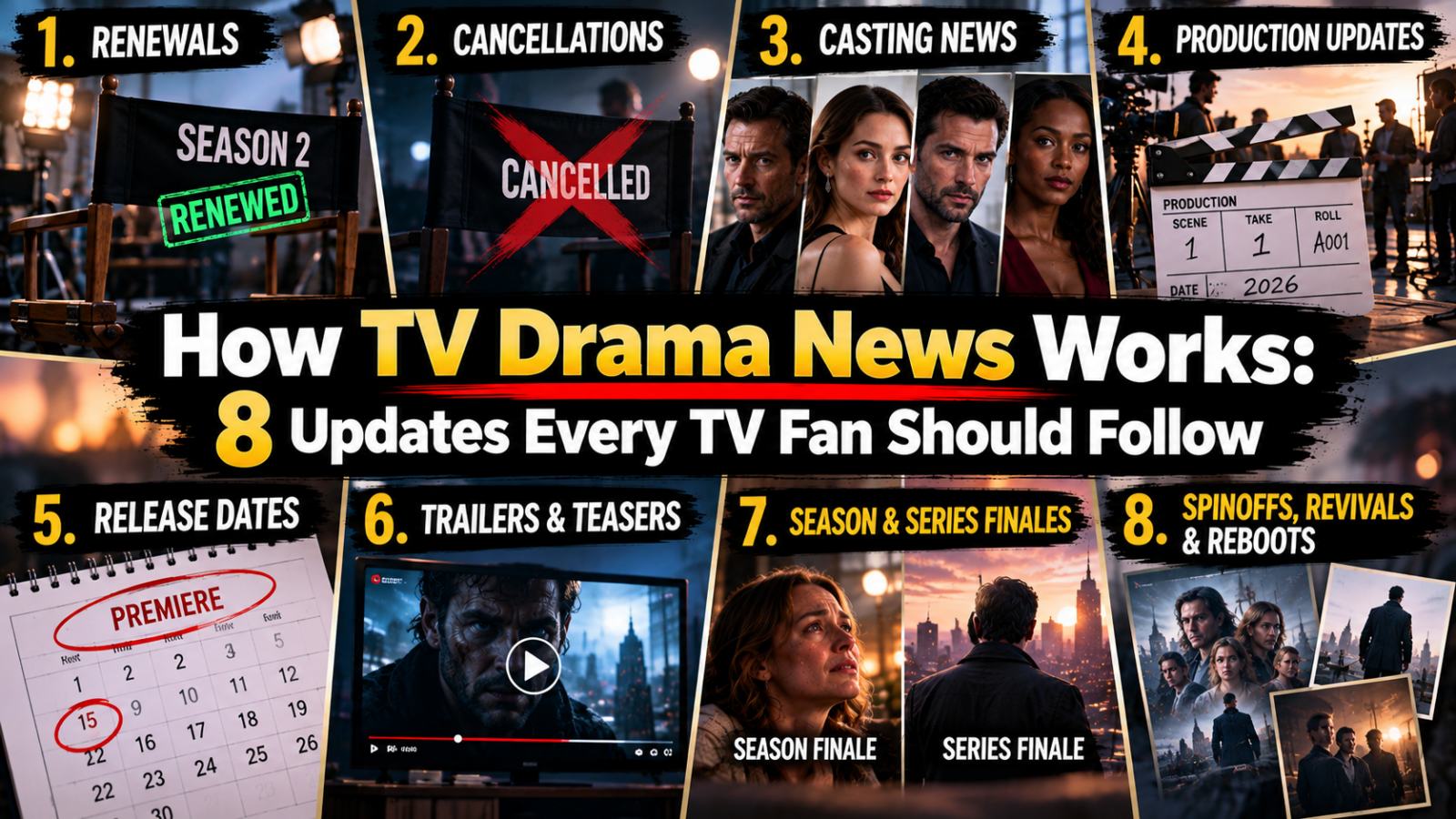
How TV Drama News Works: 8 Updates Every TV Fan Should Follow
On this page
- 1. Renewal Announcements
- 2. Cancellation News
- 3. Casting Announcements
- 4. Production Updates
- 5. Release Date Announcements
- 6. Trailers and Teasers
- 7. Season and Series Finale Updates
- 8. Spinoffs, Revivals, and Reboots
- Official News vs. Rumors
- Why Publication Dates Matter
- How We Should Cover TV Drama News
- Why Headlines Should Be Accurate
- How to Avoid Spoilers in TV News
- Final Thoughts
Following TV drama news can sometimes be almost as entertaining as watching the shows themselves.
A series gets renewed. A lead actor joins a new project. Production begins on another season. A trailer appears unexpectedly. A release date moves. Then rumors begin spreading across social media before official information is available.
For viewers, separating meaningful updates from speculation can be difficult.
Not every headline has the same importance, and not every online claim should be treated as confirmed information.
Here are eight types of TV drama updates worth understanding and following.
1. Renewal Announcements
A renewal means a network or streaming service has decided to continue a series.
For fans, this is one of the most important pieces of television news.
Renewals can happen at different times.
Some successful series receive another season before the current one finishes. Others may wait weeks or months before their future is confirmed.
A renewal announcement may also reveal additional information, such as the expected season number or whether production is planned to return during a particular period.
However, renewal does not necessarily mean a new season will arrive soon.
Writing, casting, filming, and post-production can take considerable time.
That is why viewers should distinguish between renewed and ready for release.
2. Cancellation News
Cancellation means a series will not continue with another regular season under its current arrangement.
This can happen for many reasons.
Audience size may be one factor, but production costs, contracts, scheduling, strategy, ownership, and other business considerations can also influence decisions.
Fans should therefore be cautious about assuming a single reason unless the network, platform, producers, or reliable reporting provides one.
Cancellation news can also become confusing when a show is being offered to another distributor.
Occasionally, a canceled series may find a new home, but viewers should not treat online campaigns or rumors as confirmation that a revival will happen.
Until an official announcement appears, the future remains uncertain.
3. Casting Announcements
Casting news can reveal a great deal about an upcoming drama or season.
A new actor might join as a regular character, recurring guest, antagonist, relative, colleague, or love interest.
Returning cast members can be equally important.
If a major character’s future was uncertain at the end of a season, confirmation that the actor is returning may give viewers some information about what to expect.
However, casting announcements should be discussed carefully.
Knowing that an actor appears in a new season does not necessarily reveal how large their role will be.
Likewise, an actor not appearing in an early cast announcement does not automatically confirm that their character has left.
Official information can arrive gradually.
4. Production Updates
Production news tells viewers where a project is in the process of becoming an actual television series.
Development, pre-production, filming, and post-production are different stages.
A project described as being “in development” may still be far from reaching viewers.
When filming begins, the series has reached a much more concrete stage.
After filming comes editing, visual effects where necessary, sound work, music, and other post-production tasks.
Understanding these stages helps viewers interpret TV drama news more accurately.
“Production has started” does not mean “the show is coming next week.”
5. Release Date Announcements
A confirmed release date is one of the most useful updates for viewers.
It tells audiences exactly when they can expect a premiere.
Before an official date is announced, websites and social media accounts may speculate based on production schedules or previous seasons.
These estimates can sometimes be reasonable, but they should still be identified as estimates.
A reliable article should clearly distinguish between:
Official release date
and
Expected or rumored release window
That distinction prevents speculation from being repeated as fact.
Release dates can also change, so older articles should be updated when new information becomes available.
6. Trailers and Teasers
Trailers give viewers their first substantial look at an upcoming series or season.
They can reveal tone, setting, returning characters, new conflicts, and major themes.
Teasers are often shorter and provide less context.
When analyzing a trailer, it is important not to assume that scenes appear in chronological order.
Promotional editing is designed to create excitement and curiosity.
Two shots placed together in a trailer may come from completely different moments in the finished episode.
For that reason, trailer analysis should separate what is clearly shown from theories about what those images might mean.
7. Season and Series Finale Updates
The words season finale and series finale sound similar but mean very different things.
A season finale concludes the current season.
The show may return.
A series finale is intended to conclude the television series itself.
Confusion between these terms can create misleading headlines.
There is another complication: sometimes a season finale becomes the final episode because the show is canceled afterward.
In that situation, the episode may function as the end of the series even though it was not originally produced as a planned series finale.
Accurate wording matters when reporting these updates.
8. Spinoffs, Revivals, and Reboots
Popular television properties can continue in several ways.
A spinoff follows a different character, location, organization, or part of an existing fictional world.
A revival generally brings back a previous series or its characters after the original run has ended.
A reboot starts the concept again, often with a new interpretation, cast, continuity, or creative direction.
These terms are sometimes used loosely online, but they describe different approaches.
When a new project is announced, understanding which type it is helps viewers know whether they should expect continuation or reinvention.
Official News vs. Rumors
One of the most important skills when following entertainment news is identifying the source.
Official information may come from a network, streaming platform, studio, production company, verified project account, or directly involved creators and performers.
Established entertainment publications can also provide reliable original reporting.
Rumors are different.
A social media post repeating information from an unnamed source should not automatically be presented as confirmed.
The safest approach is simple:
If something has not been officially confirmed or reliably reported, describe it as unconfirmed.
Do not turn speculation into fact simply because many accounts repeat it.
Why Publication Dates Matter
Entertainment news changes quickly.
An article saying that a show’s future is unknown may be accurate on Monday and outdated by Friday if a renewal is announced.
Always check when information was published or last updated.
This is particularly important for release dates, production status, casting, renewals, and cancellations.
For US Drama Hub, we should also update older articles when important new information becomes available.
That gives readers a clearer picture than publishing a new page for every tiny change.
How We Should Cover TV Drama News
For US Drama Hub, our news articles should answer the most useful questions first.
What happened?
Who confirmed it?
When was it announced?
What does it mean for viewers?
What remains unknown?
After those questions are answered, we can provide relevant background about the show.
This structure keeps news useful instead of padding articles with unrelated information.
Why Headlines Should Be Accurate
A headline should communicate the actual development.
If a show has only been rumored to return, the headline should not say that a new season is confirmed.
If an actor says they would like to return, that does not mean they have signed a contract.
Likewise, “in development” does not necessarily mean “coming soon.”
Accurate headlines build reader trust.
They also make articles more useful months later when someone discovers them through search.
How to Avoid Spoilers in TV News
Some entertainment news naturally contains spoilers.
Casting information, episode descriptions, trailers, and interviews may reveal story details.
When a major spoiler is necessary, readers should receive a clear warning before the information appears.
Titles and featured images should be handled especially carefully.
A reader should not have an important character death or twist revealed simply because an article appeared on the homepage.
Spoiler awareness makes the site more enjoyable for readers who watch shows at different speeds.
Final Thoughts
Following TV drama news becomes much easier when you know what each type of announcement actually means.
Renewals and cancellations determine whether stories continue. Casting and production updates reveal how future seasons are developing. Release dates tell viewers when they can watch, while trailers offer the first clues about upcoming stories.
Spinoffs, revivals, and reboots can extend familiar television worlds in completely different ways.
Most importantly, reliable entertainment coverage should clearly distinguish confirmed information from rumors and speculation.
That principle will guide the TV News coverage on US Drama Hub as we follow American television and the stories viewers care about.